Choosing a Chinese Wooden 3d Puzzle manufacturer takes more than comparing catalog photos and unit prices. Circana reported that toy sales declined 7% across 12 tracked global markets in 2023. That shift makes reliable product quality, cost control, and clear production records especially important for buyers. Still, broad toy-market figures do not tell us how wooden puzzle suppliers perform. That distinction matters.
A useful comparison looks closely at the product itself. Examine the plywood or other wood material, piece thickness, cutting accuracy, and the finish along each edge. Ask how the factory checks for splinters, loose-fitting pieces, and inconsistent colors between batches. Request current samples, packaging details, production lead times, and documentation for the markets where the puzzles will be sold. FSC Chain of Custody records may help buyers verify sourcing claims; ISO 8124 offers relevant toy-safety standards. Neither replaces checking the finished product and its applicable compliance documents.
The manufacturers featured in this guide are assessed through practical factors: product range, manufacturing capability, quality-control evidence, customization, and export experience. No ranking can capture every factory’s performance on every order. A polished sample can still differ from a bulk shipment. Buyers should confirm specifications in writing and inspect production samples when feasible. The goal here is not to declare one supplier best for every project, but to help identify partners worth evaluating further.
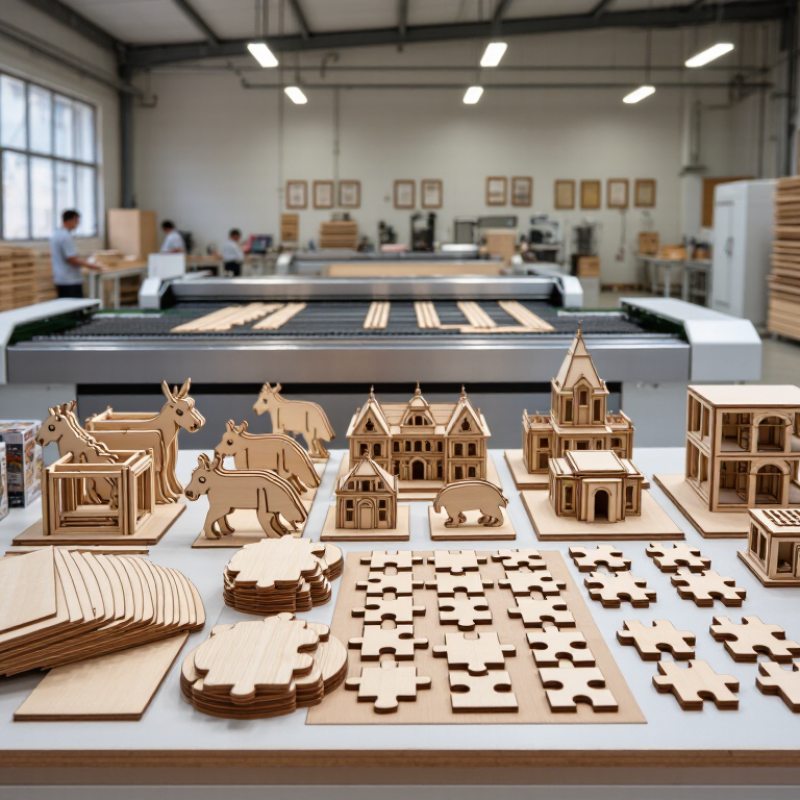
What Are Wooden 3D Puzzles and How Are They Made?
Wooden 3D puzzles are flat-cut pieces that lock together to form a three-dimensional model. They may become animals, vehicles, buildings, or moving mechanisms. Unlike conventional jigsaws, many designs rely on slots, tabs, and numbered parts. Some need no glue, though a little adhesive can help with certain models. Small parts matter.
Production starts with a digital design. Designers plan how each piece supports the finished structure, then arrange the parts on thin plywood sheets to limit waste. A laser cutter follows the outlines and may mark numbers or fold lines. Material choice matters: plywood thickness, grain direction, and moisture can all affect the fit. The cut is precise, but not magical.
After cutting, workers check for missing details, rough edges, and excessive scorching. Pieces may be lightly sanded, sorted, and packed with instructions. A sample assembly can reveal joints that are too tight or steps that are unclear. Fit is everything. Even careful testing can miss a stubborn tab or a confusing diagram, so builder feedback can help improve later versions.
About wooden 3D puzzles: Designs are typically created digitally, then their interlocking pieces are cut from sheet material—often by laser—and finished for assembly. The chart shows example nominal plywood thickness options, not market-share data or a manufacturer ranking; actual materials vary by product and supplier.
How Has China’s Wooden Puzzle Industry Developed?
China’s wooden puzzle industry has developed alongside the country’s wider toy and wood-products manufacturing base. Earlier products often used simple shapes, manual sanding, and straightforward packaging. As workshops adopted digital design tools and more precise cutting equipment, they could create tighter-fitting parts and more detailed scenes. The change is visible in the pieces: layered rooftops, tiny gears, and tabs that fit without force. Not everywhere, though. Production methods still vary between factories.
Export demand helped many manufacturers refine packaging, production planning, and consistency. More recently, interest in hands-on activities has encouraged designs for family play, display, and learning. Good results depend on more than intricate artwork. Wood thickness, grain direction, moisture, and cleanly finished edges all affect how a puzzle assembles. A careful maker checks whether pieces release smoothly and whether small components remain sturdy. Progress has been uneven, and an attractive prototype does not always perform well in repeated use. That gap is worth examining. As design software improves, skilled workers still matter for sanding, inspection, and catching defects that machines may miss.
Which Companies Are Leading Wooden 3D Puzzle Manufacturers in China?
China’s leading wooden 3D puzzle manufacturers are best identified by production capability, not catalog size. Look for factories that control laser cutting, sanding, printing, and assembly, and can show stable tolerances across repeat orders. A well-cut gear should turn smoothly; rough edges around tiny slots tell another story. Ask for material specifications, sample inspection records, and documented checks for fit and finish. Small details matter.
Trade data offers useful context, but not a precise league table. The China Toy and Juvenile Products Association’s 2024 industry review reported roughly US$40.7 billion in Chinese toy exports for 2023. That figure covers toys broadly, not wooden 3D puzzles. UN Comtrade’s broad toy trade classifications likewise do not isolate this product niche. So claims that one supplier is definitively “number one” need independent, product-specific evidence. A neat catalog is not proof. Buyers can compare manufacturers through verified puzzle shipments, customization capability, production capacity, and third-party quality audits. Request a pilot batch, then check whether tabs fit without force and printed instructions match the assembled model. Even a polished sample can hide inconsistent mass production.
Who Are the Top Wooden 3D Puzzle Manufacturers in China? - Which Companies Are Leading Wooden 3D Puzzle Manufacturers in China?
This comparison framework avoids unsupported company rankings. It identifies practical, verifiable criteria for assessing wooden 3D puzzle manufacturers; results should be confirmed directly with each supplier.
| Comparison Dimension |
What to Assess |
Evidence to Request |
| Product range |
Whether the supplier makes mechanical models, vehicle kits, architectural models, or other wooden assembly puzzles. |
Current catalogue, sample products, and confirmation of which items are produced in-house. |
| Material specifications |
Wood type, sheet thickness, surface finish, and consistency between production batches. |
Material specifications, sample inspection, and relevant test reports for the intended market. |
| Cutting and fit |
Cleanly cut parts, legible part identification, and pieces that fit together as intended. |
A production sample, assembly trial, and documented inspection process. |
| Design and engineering |
Ability to develop original designs or adapt customer artwork, instructions, and packaging. |
Design workflow, prototype approval steps, and written confirmation of design ownership and usage rights. |
| Quality control |
Checks for missing or damaged pieces, print quality, assembly accuracy, and packaging condition. |
Quality procedures, sample inspection records, and a clear process for handling defects. |
| Safety and compliance |
Whether product materials, labeling, and testing meet the legal requirements of the destination market and intended age group. |
Applicable test reports and certificates verified for the specific product and sales market. |
| Customization and packaging |
Options for branding, instruction languages, box design, and retail-ready packaging. |
Packaging samples, artwork approval process, and itemized customization terms. |
| Production and delivery |
Quoted minimum order quantity, production lead time, shipping options, and capacity for repeat orders. |
A written quotation, production schedule, and agreed shipping and reorder terms. |
A reliable shortlist should be based on verified samples, product-specific compliance documents, clear commercial terms, and independently checked supplier information—not on an unverified “top manufacturer” ranking.
How Do China’s Top Manufacturers Differ in Design and Production?
China’s wooden 3D puzzle manufacturers can differ most in how they turn a sketch into a buildable model. Some favor clean, geometric designs with fewer parts. Others create layered vehicles, buildings, or animals with moving details. A useful sample should show more than appearance. Check whether tabs fit snugly, pieces release cleanly, and the instructions match the actual assembly steps. Small gaps matter.
Production methods also shape the finished puzzle. Laser cutting can create precise edges and fine details, while material choice affects strength, color, and surface feel. Ask how the factory checks sheet thickness, cutting accuracy, and part counts. A clear answer is more useful than a broad promise of “high quality.” Ask for a pre-production sample, too. It may reveal issues that digital drawings miss.
Customization is another point of difference. One manufacturer may handle small design changes carefully but need more time for testing. Another may be better set up for repeat production, though unusual shapes can require extra adjustment. Neither approach is automatically best. One detail is easy to overlook: very intricate parts look impressive, but can frustrate younger builders or break during handling. A good design balances visual detail with practical assembly. Even experienced teams can miss something, so feedback from real users should guide revisions.
What Factors Help Compare Chinese Wooden Puzzle Manufacturers?
The top wooden 3D puzzle manufacturers in China are not judged by catalogs alone. In my experience, comparison begins with production consistency. Check wood species, moisture control, cutting accuracy, and edge smoothness. A reliable factory should explain these processes clearly. Ask for recent samples from different production batches. One attractive sample proves little.
Material safety also matters. Request documented testing for coatings, adhesives, and small parts. Confirm whether the factory follows applicable product safety requirements for your target market. Packaging deserves equal attention. Strong partitions, clear assembly instructions, and moisture-resistant cartons reduce damage during shipping. These details often reveal practical manufacturing experience.
Communication can separate a capable supplier from a merely cheap one. Compare response speed, technical drawings, prototype revisions, and tolerance control. A professional team should identify design problems before mass production. Ask how it handles warped plywood, missing pieces, or color differences. No factory is perfect. I would not rely on promises alone. Visit the workshop, inspect quality records, and speak with production staff when possible. Certifications can support trust, but they should match the actual facility and product. The best comparison combines evidence, repeatable quality, transparent pricing, and a willingness to admit limitations.
Conclusion
Wooden 3d Puzzle products combine creative design, precision cutting, and hands-on assembly to transform flat wooden sheets into detailed three-dimensional models. They are typically made through computer-aided design, laser or mechanical cutting, careful material selection, and quality inspection. China’s wooden puzzle industry has developed through improvements in manufacturing technology, skilled labor, efficient supply chains, and growing demand for educational, decorative, and hobby products. These advantages have helped manufacturers offer a wide range of themes, difficulty levels, sizes, and customization options.
Leading Chinese manufacturers differ in their design capabilities, production equipment, material quality, assembly accuracy, packaging, and ability to handle small or large orders. Some focus on artistic details and unique model development, while others emphasize cost efficiency, fast delivery, or flexible customization. When comparing suppliers, buyers should consider product safety, wood sourcing, cutting precision, sample quality, production capacity, quality control, communication, and after-sales support. A reliable manufacturer should balance attractive design, durable construction, consistent quality, and responsible production.

 CraftODM