Choosing a 3d Moving Puzzle for a child involves more than colorful pieces and clever mechanisms. The right design should match the child’s age, hand strength, attention span, and problem-solving experience. A puzzle with sliding gears may excite a ten-year-old but frustrate a preschooler. Small parts also require careful age checking.
Market evidence supports this thoughtful approach. The NPD Group, now Circana, reported that global toy sales reached approximately $108.7 billion in 2023, despite a 7% decline from the previous year. Its industry analysis highlighted continued interest in games, learning products, and toys that encourage active participation. The Toy Association has also identified STEM-focused play as a lasting consumer interest, especially when children can experiment rather than follow one fixed answer. These figures describe market behavior, not guaranteed educational outcomes. That distinction matters.
Erno Rubik, creator of the Rubik’s Cube, once wrote, “The cube is an imitation of infinity.” His observation explains why three-dimensional puzzles remain compelling: each movement changes the next possibility. However, not every 3d Moving Puzzle offers meaningful challenge. Parents should examine turning resistance, rounded edges, material quality, solution guidance, and whether the puzzle allows independent success. A smooth click can invite another attempt. A stiff mechanism may simply be discouraging.
This guide compares practical features, developmental value, safety considerations, and real play experience. It also questions a common assumption: harder does not always mean better. A thoughtfully chosen puzzle should stretch a child’s thinking without making the first five minutes feel impossible.
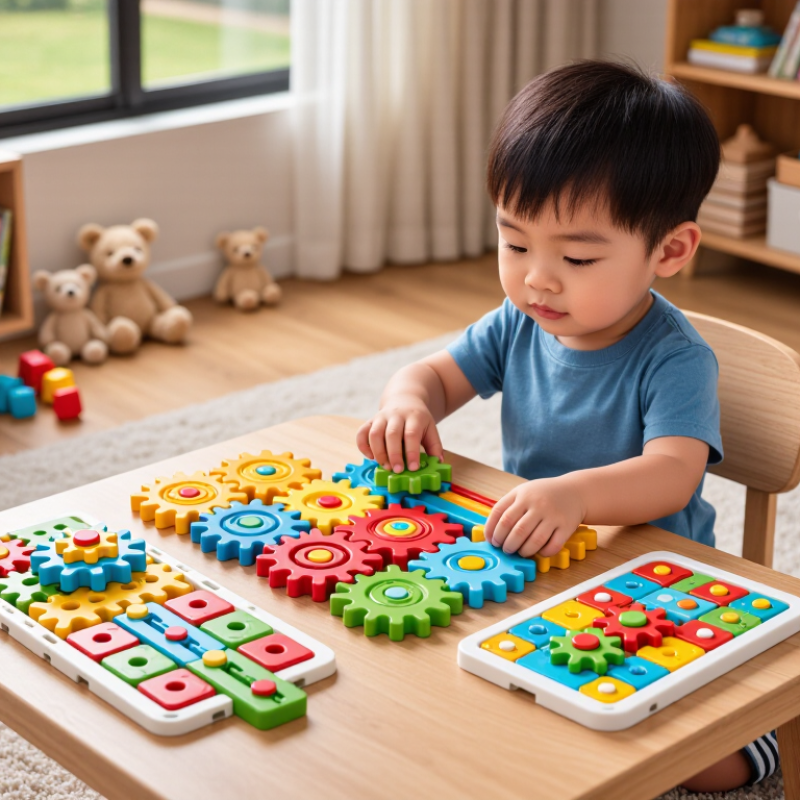
A 3D moving puzzle is more than a flat picture with extra layers. Inside, gears, sliders, tracks, magnets, or rotating blocks transfer movement between parts. When a child turns one wheel, another piece may shift, lock, or rise. This makes cause and effect visible. It also creates small problem-solving challenges. Circana’s 2023 U.S. toy industry report valued the market at about 28.6 billion dollars, showing strong demand for play products with hands-on interaction. However, popularity does not prove learning value.
Look for a puzzle with smooth movement, clear instructions, and a manageable number of steps. A child should understand the first action without constant adult rescue. Safety matters too. The U.S. Consumer Product Safety Commission estimated 231,700 toy-related emergency-room injuries in 2023. Therefore, check age guidance, secure pieces, and possible small parts before buying. Avoid mechanisms that pinch fingers or release loose magnets. The American Academy of Pediatrics also recommends choosing toys that encourage active, shared play instead of passive entertainment.
Watch the child’s reaction. A difficult puzzle can build persistence, but repeated failure may reduce confidence. I would not assume that a more complicated mechanism is automatically better. Sometimes, a simple rotating maze offers richer play than a crowded gear system. Children also differ in patience, hand strength, and spatial experience. That part is easy to overlook. A good choice leaves room for mistakes, experimentation, and a little conversation beside the puzzle.
How to Choose the Best 3D Moving Puzzle for Kids?
Identifying the Right Puzzle for a Child’s Age
Age is the most practical starting point when choosing a 3D moving puzzle for children. A puzzle should challenge a child without making every attempt feel impossible. For ages three to five, choose large pieces, simple pathways, and slow-moving parts. Avoid small detachable pieces, especially around younger children. Bright colors and clear shapes can help children match, rotate, and stack with confidence.
Children aged six to eight can usually manage puzzles with several steps, gears, sliders, or hidden routes. Look for sturdy construction and movement that feels smooth, not loose or forced. At this stage, children often enjoy solving a visible problem independently. Still, frustration can appear quickly. A puzzle marked for an older age may be unsuitable if its instructions are complex or its pieces require advanced hand control.
Older children may enjoy layered designs, timed challenges, and puzzles with multiple solutions. Check whether the difficulty matches their patience and previous experience. An age label is helpful, but it is not perfect. A careful adult should observe the child’s grip, attention, and emotional response. Is the child experimenting, or simply guessing? That difference matters. In my view, the best choice leaves room for mistakes while keeping the moving parts safe. Sometimes a simpler puzzle creates deeper learning than an impressive, complicated one.
Piece-count guidance is a practical starting point rather than a strict rule. Younger children usually benefit from larger pieces, simple movement mechanisms, and clear visual goals, while older children can manage smaller parts, more complex connections, and higher piece counts. Always follow the manufacturer’s recommended age range and supervise children around small parts.
Choosing a 3D moving puzzle starts with its materials. Hardwood feels warm and stable, while high-quality plastic can offer smoother gears and easier cleaning. Look for rounded edges, secure axles, and water-based coatings with documented migration testing. ASTM F963 and EN 71-3 provide useful benchmarks for mechanical and chemical safety. Material claims still need verification.
Design affects both learning and daily use. A good puzzle should provide visible movement without exposing sharp pins, loose springs, or finger-trapping gaps. Pieces should resist rough handling but remain light enough for small hands. In my view, moderate resistance is better than effortless spinning; children learn more when each turn feels purposeful. I once focused too much on attractive colors. That was a weak test. Surface appeal cannot reveal hidden hazards.
Safety deserves measurable attention. The U.S. Consumer Product Safety Commission reported about 231,700 toy-related emergency-department injuries involving children under 15 in 2023. The European Commission’s 2023 Safety Gate report listed toys among leading notified product categories, representing 13% of alerts. These figures do not prove every puzzle is risky, but they justify careful inspection. For children under three, avoid detachable pieces, magnets, and components that fit through a small-parts test cylinder. Check the age label, ventilation instructions, and cleaning guidance. Move every gear slowly. Listen for cracking. If a piece loosens after repeated use, the puzzle should leave the play area, even when its design still looks attractive.
A 3D moving puzzle should challenge a child without turning every attempt into a dead end. Start by checking the recommended age, piece count, and movement range. Then test one step. Can a child predict the next turn after watching once? If adults must solve the mechanism repeatedly, the difficulty is probably misplaced.
Circana’s 2023 Global Toy Industry Report recorded a 7% decline in toy sales, reaching $108.7 billion across 12 markets. That pressure makes durable play value important, not decorative complexity. Choose sturdy parts, clear feedback, and more than one solution path. A useful puzzle should invite replay, peer cooperation, and small self-corrections. Look for clicking gears, sliding tracks, or pieces that visibly change position.
Learning benefits deserve careful scrutiny. The OECD PISA 2022 creative-thinking assessment covered 64 education systems and examined generating, evaluating, and improving ideas. A moving puzzle can rehearse these habits through sequencing, spatial reasoning, persistence, and verbal explanation. Still, the transfer is not automatic. A child may rotate pieces skillfully without explaining why the design works. Ask the child to predict, test, and revise. That conversation reveals more learning than a fast completion time. The American Academy of Pediatrics’ 2018 clinical report connects guided play with language, self-regulation, and problem-solving development. Yet no single puzzle guarantees these outcomes. I would record frustration, repeated attempts, and independent discoveries during real play. Those imperfect observations matter.
| Puzzle Type | Recommended Age | Typical Parts | Difficulty | Average Play Time | Main Learning Benefits | Play Value | Safety and Selection Notes |
|---|---|---|---|---|---|---|---|
| Large-Piece 3D Shape Puzzle | 3–4 years | 8–20 pieces | Easy · 1/5 | 10–15 minutes | Shape recognition, hand–eye coordination, color matching, and basic spatial vocabulary. | ★★★★☆ | Choose oversized pieces with smooth edges. Avoid loose parts that can fit completely inside a small-parts test cylinder. |
| Interlocking 3D Animal or Vehicle | 4–6 years | 12–30 pieces | Easy to Moderate · 2/5 | 15–25 minutes | Sequencing, visual discrimination, fine-motor control, and following simple construction steps. | ★★★★★ | Look for thick, durable pieces and a stable finished model. Adult supervision is recommended for younger children. |
| Rotating Gear-and-Track Puzzle | 5–7 years | 20–45 parts | Moderate · 3/5 | 20–35 minutes | Cause-and-effect reasoning, mechanical thinking, prediction, persistence, and problem solving. | ★★★★★ | Check that moving gears are enclosed or securely mounted and that the mechanism moves without excessive force. |
| Marble-Run Construction Puzzle | 6–8 years | 30–70 parts | Moderate · 3/5 | 30–45 minutes | Gravity concepts, planning, experimentation, spatial reasoning, and iterative design. | ★★★★★ | Use only with children old enough to handle small balls safely. Confirm that the base is stable and parts connect firmly. |
| 3D Maze with a Moving Ball | 7–9 years | 1 enclosed maze | Moderate to Challenging · 3.5/5 | 15–30 minutes | Concentration, visual-spatial processing, motor planning, patience, and route evaluation. | ★★★★☆ | An enclosed design reduces the risk of losing the ball. Select a size that is comfortable for smaller hands. |
| Multi-Layer Mechanical Puzzle | 8–10 years | 40–90 parts | Challenging · 4/5 | 35–60 minutes | Systems thinking, working memory, sequencing, attention to detail, and independent troubleshooting. | ★★★★★ | Choose models with clear instructions, replaceable components where possible, and no sharp metal edges. |
| Build-and-Program Motion Puzzle | 9–12 years | 50–120 parts | Challenging · 4.5/5 | 45–90 minutes | Computational thinking, logical reasoning, planning, testing, and creative problem solving. | ★★★★★ | Verify age-appropriate software, low-voltage components, secure battery access, and adult support during setup. |
| Advanced 3D Logic Assembly | 10–14 years | 80–180 parts | Very Challenging · 5/5 | 60–120 minutes | Abstract reasoning, mental rotation, error analysis, perseverance, and long-term project planning. | ★★★★☆ | Best for experienced puzzle solvers. Confirm that the instruction sequence is complete and that replacement parts are available. |
Selection tip: Start with a puzzle that can be completed successfully with moderate effort. A suitable challenge should encourage persistence without causing repeated frustration; age guidance, part size, and adult supervision should always be considered together.
Choosing a 3D moving puzzle for home or travel requires more than counting pieces. The puzzle should match the child’s age, patience, and hand strength. For younger children, choose large parts, rounded edges, and securely enclosed components. Loose small pieces can become a safety concern.
At home, a larger puzzle with gears, sliders, or rotating sections can create a satisfying play station. A stable base matters. It prevents the puzzle from shifting across the table during assembly. Check the construction carefully. Parts should move smoothly without sharp edges, strong resistance, or unusual odors.
Travel needs different priorities. Select a compact puzzle with a firm storage case or connected pieces. Magnetic designs can help, but magnets must remain securely sealed. A child should not need a table to complete the activity. I once chose a beautiful puzzle that was too complicated for a short train ride. It stayed unfinished in the bag. That mistake changed my approach.
Test the puzzle before leaving home. Time one practice session. Notice whether pieces fall out when the case tilts. Listen for loose components. A quiet design is also useful in cars, waiting rooms, and airplanes. Instructions should use clear pictures and simple steps. If the puzzle offers too little challenge, children may lose interest quickly. If it demands constant adult help, independent play becomes difficult. A slightly imperfect fit may be acceptable, but frustrating movement is not.
It combines spatial pieces with gears, sliders, tracks, magnets, or rotating blocks. One movement can shift another part. Cause and effect becomes visible.
Check the age guidance, piece count, movement range, and instructions. The first action should be understandable without constant adult help. Keep the challenge manageable.
Hardwood feels stable and warm. Quality plastic may provide smoother gears and easier cleaning. Choose rounded edges, secure axles, and tested surface coatings.
Inspect gaps, springs, pins, magnets, and detachable pieces. Avoid loose parts and finger-trapping spaces. Move each gear slowly. Listen for cracking.
Follow the stated age guidance carefully. Very young children should avoid small detachable pieces and loose magnets. Supervision still matters, even with familiar designs.
A child should predict a next movement after watching once. Repeated failure can reduce confidence. Moderate resistance often feels more purposeful than effortless spinning.
Children can practice sequencing, spatial reasoning, persistence, and verbal explanation. Ask them to predict, test, and revise. Fast completion is not everything.
Sit nearby and ask, “What might move next?” Let the child make mistakes before helping. Shared play may encourage language and self-correction.
No. A simple rotating maze may offer richer play than crowded gears. I once judged puzzles by colorful surfaces. That was a weak test.
Remove it when a piece loosens, cracks, pinches, or behaves unpredictably. Attractive design cannot compensate for damaged parts. Safety comes before replay value.
Choosing the best 3d Moving Puzzle for a child begins with understanding how its three-dimensional pieces shift, rotate, or slide to create new patterns and solving opportunities. Parents should select a design that matches the child’s age, attention span, and coordination level. Younger children may benefit from larger, simpler pieces, while older kids can enjoy more complex movement systems and challenging goals.
When comparing puzzles, consider durable, non-toxic materials, smooth edges, secure parts, and a design that is comfortable for small hands. The ideal puzzle should offer enough difficulty to encourage problem-solving without causing frustration, while also supporting spatial awareness, patience, concentration, and creativity. For home use, a larger or more detailed puzzle may provide extended play value. For travel, choose a compact, lightweight option with pieces that stay organized and are easy to carry.

CraftODM